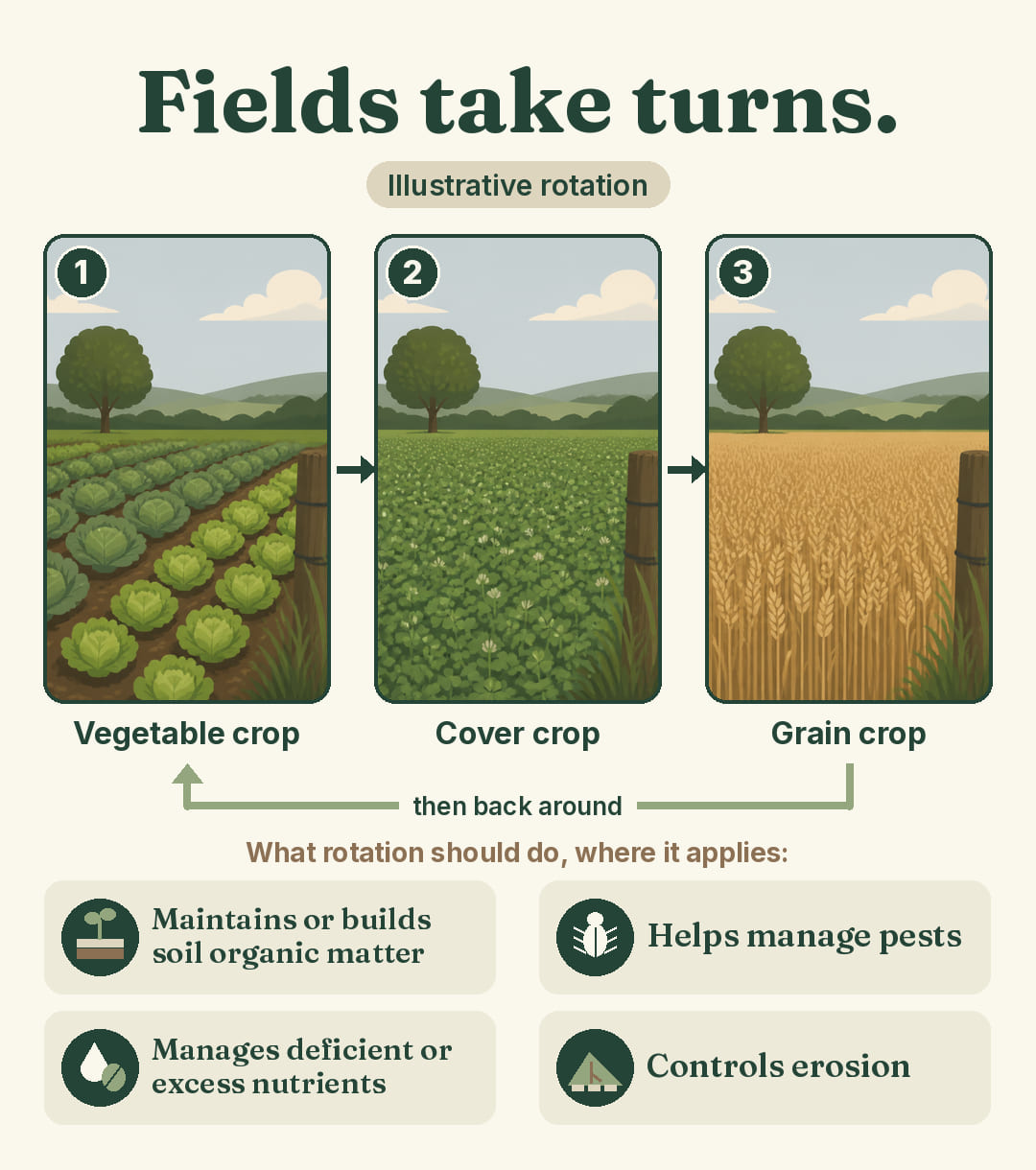
Illustrative rotation. Source: 7 CFR 205.205.
November 11, 2026
Why organic fields take turns
certification process · records

Purl Ambrose
Writes Purl of Wisdom
Organic farms have to rotate crops, and the rule says what the rotation has to do. Here's what that means and how it gets checked.
Walk an organic farm across a few seasons and the same field won't always hold the same crop. That's on purpose, and it's in the rules.
The rules define crop rotation as alternating the annual crops grown on a specific field in a planned pattern or sequence over successive crop years, so crops of the same species or family aren't grown on the same field again and again without a break.
Organic producers have to put a crop rotation in place. The rule names kinds of crops it can include, among them sod, cover crops, green manure crops, and catch crops. Then it lists the jobs the rotation has to do, as they apply to the operation:
- • maintain or improve the soil's organic matter
- • provide for pest management in annual and perennial crops
- • manage plant nutrients that are deficient or in excess
- • provide erosion control
Orchards and other perennial crops can't rotate the same way. For those, the definition points to other ways to bring in biological diversity: alley cropping, intercropping, and hedgerows.
The rotation belongs in the organic system plan, which describes each practice and how often it's done. At inspection, the inspector verifies that the plan accurately reflects what's really happening on the ground.
So a field that changes crops isn't indecision. It's the plan, written down and checked.
— Purl